

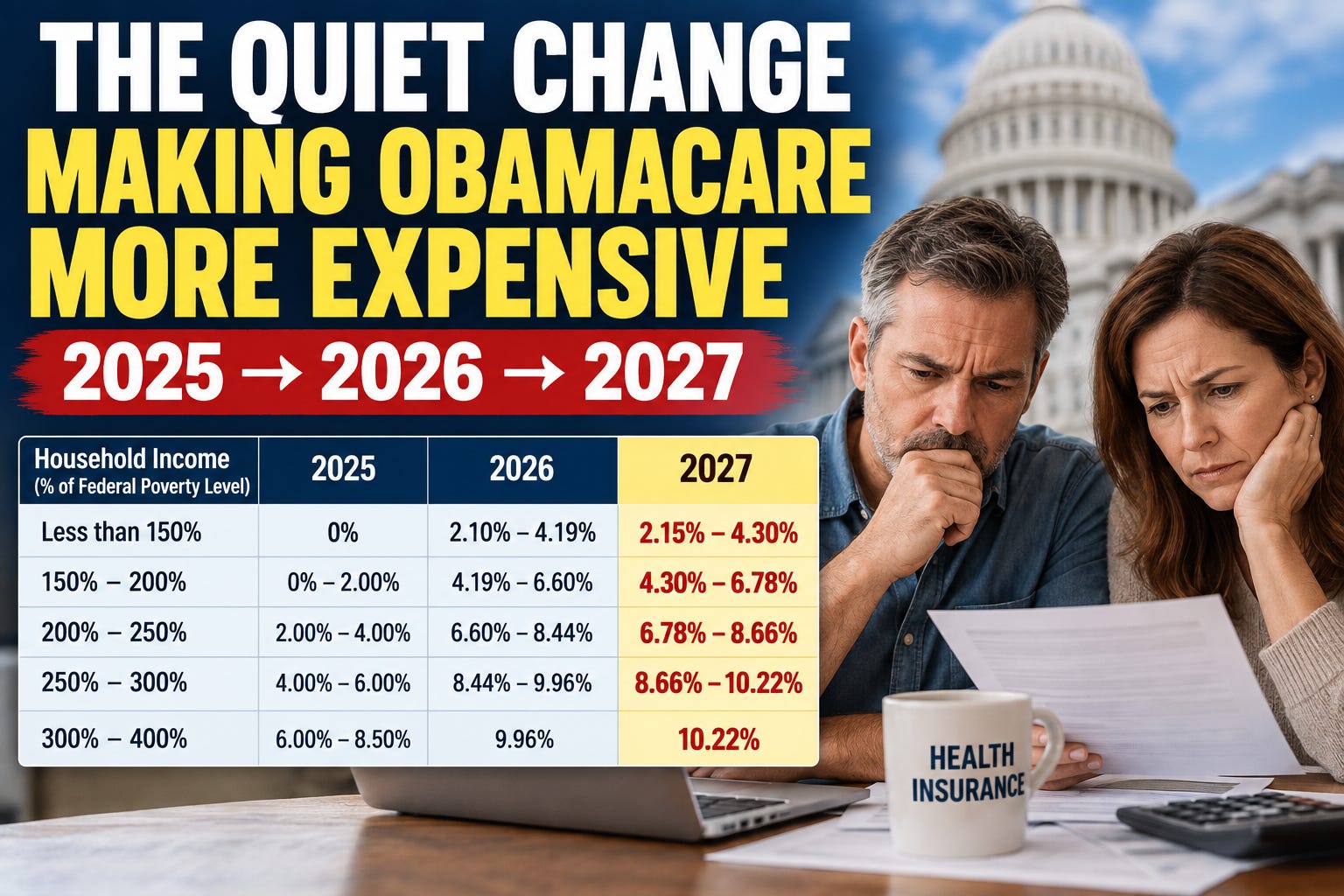
Written 9/28/2026
I was looking at the new 2027 numbers for the Marketplace and something jumped out at me.
But to really understand it, we have to go back to 2025.
In 2025, if you made less than 150% of the Federal Poverty Level, the government expected you to spend 0% of your income toward the benchmark Marketplace plan.
Zero.
If you were between 150% and 200% of the poverty level, it was between 0% and 2%.
Between 200% and 250%, 2% to 4%.
Then we got to 2026.
The enhanced subsidies that had been in place expired at the end of 2025, and the percentages changed dramatically.
Someone below 133% of the poverty level went from 0% to 2.10%. (For those states without enhanced subsidies).
If you are at 133% of the poverty line, then your percentage is now 2.15%.
Someone between 150% and 200% went from 0%–2% to 4.19%–6.60%.
Someone between 250% and 300% went from 4%–6% to 8.44%–9.96%.
That’s a pretty substantial change in one year.
Now we have the numbers for 2027.
And they’re going up again.
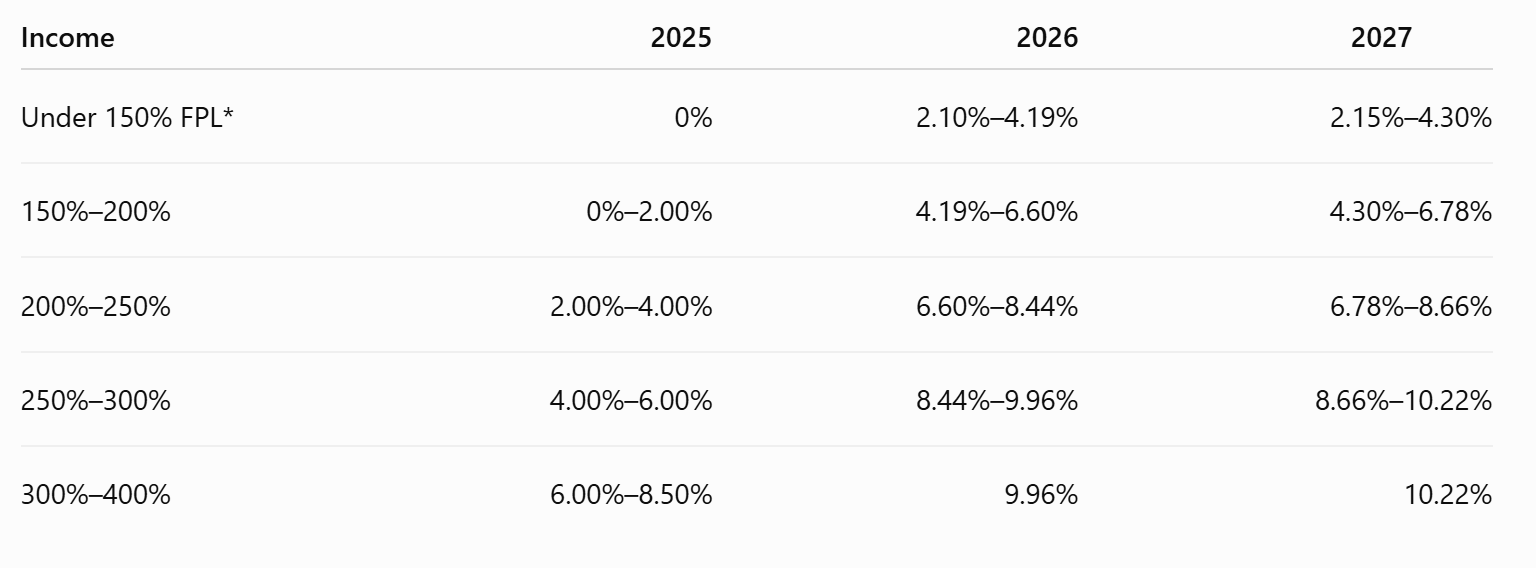
*The income brackets aren’t identical between the years, so I’ve combined the under-150% numbers to make the comparison easier to understand.
Here’s why this matters.
These percentages are used to determine how much you’re expected to contribute toward the benchmark Marketplace plan. Your subsidy is then calculated based, in part, on that amount.
So, everything else being equal:
Higher percentage = you pay more.
And look at what happened at 200% of the poverty level.
In 2025, the applicable percentage was about 2%.
In 2026: 6.60%
In 2027: 6.78%
That’s a big difference.
There’s something else interesting happening at the same time.
For people who get insurance through a large employer, the ACA affordability percentage has also gone up:
2025 — 9.02%
2026 — 9.96%
2027 — 10.22%
I’ve been doing this for more than two decades, and one thing that drives me crazy about healthcare is how we talk about numbers like these.
2%.
6%.
10%.
They don’t sound like much.
But tell someone who’s trying to pay their mortgage, buy groceries, make a car payment and maybe put a little money away that another $50 or $100 a month “isn’t much.”
It matters.
The biggest change happened between 2025 and 2026 because the enhanced Marketplace subsidies expired.
But 2027 continues moving in the same direction.
You’re being asked to pay a larger percentage of your income toward health insurance.
So if you’re buying coverage through the Marketplace, don’t assume what you paid this year is what you’ll pay next year.
Look at your numbers when Open Enrollment begins.
You may be surprised.
Checked the tables against the primary sources before trusting them, and most of this holds.
2026 (Rev. Proc. 2025-25): under 133% FPL = 2.10%; 150-200% = 4.19-6.60%; 250-300% = 8.44-9.96%; required contribution = 9.96%.
2027 (Rev. Proc. 2026-26): 150-200% = 4.30-6.78%; required contribution = 10.22%.
The 9.02 / 9.96 / 10.22 series is correct. One small slip: at exactly 133% of FPL for 2026 the table opens at 3.14%, not 2.15% - 2.15% is the 2027 under-133% figure, so it looks like the two years got crossed on that line.
I do this for a living: source-checking the numbers in health and care writing before it goes out. If you ever want a second pair of eyes on a draft, a full source pass is $20 here: https://buy.stripe.com/eVq00j0nJgk86TXeUd5kp0Q
Either way, good piece - the "it's only 2%" point is the right one to make.